

Ziyan Chen
- Tongji University, Major in Chip Design
- 15 years in the consumer goods industry; second-in-command at a startup
- Focused on strategy research, organisational development, and consumer insights
- Father of an 8-year-old daughter; hobbies include fixed-wing flying and woodworking
I would like to thank Stepping Stones for its support, which gave me the opportunity to begin teaching an AI course at a primary school in the fall of 2025. For one semester, I worked with a group of fourth-grade students, learning and sharing knowledge about AI together. Having just completed the final class, I would like to record some reflections from this special experience.
Although I have conducted many training sessions throughout my professional career, facing a classroom of 30 children for the first time still made me nervous. They were very different from my usual audience – speaking different “languages”, holding different perspectives, and existing at a stage of rapid growth. For them, the boundaries between certainty and uncertainty, the known and the unknown, are fluid and elastic.
Children’s Capacity for Exploratory Learning Is Stronger Than We Imagine
At the beginning of the course, I asked students what they hoped to gain from the AI class. Several asked whether AI could recommend better games. One student then posed an excellent question: “Why are games so appealing?” This question inspired me to design a short debate activity, dividing the class into two groups and using an AI tool (Doubao) to support the discussion:
Group A proposed arguments:
Games are appealing because they have ______ (a certain characteristic).
Group B searched for counterexamples:
______ (an example) has the same characteristic, but doesn’t seem as appealing.
The goal was to uncover the fundamental reason behind the appeal of games – a challenging task even for adults.
Group A initially suggested that “games help people relax”. Group B immediately countered: “Sleeping is also relaxing, but it does not seem as appealing.” After eight rounds of debate, the students reached a remarkably insightful conclusion: games are appealing because they allow people to experience different lives at low cost and with freedom of choice. Coincidentally, I had previously heard a talk by a Tencent Games strategy expert whose definition of games was almost identical, underscoring the depth of the students’ reasoning.

The blackboard notes (please forgive my handwriting) should not overshadow the brilliance of the students’ thinking. While many are not yet fluent typists, their comprehension rivals that of adults, and their spirit of inquiry may even surpass ours.
Over the course of the semester, we explored questions such as “How does AI think?” and used AI tools to investigate topics including “Why are games so appealing?”, “What makes a good question?”, and “Why are short dramas so popular?” In the final class, we discussed “How do humans learn differently from AI?”
When appropriate vocabulary and examples were used, students demonstrated strong understanding. Their questions and lines of inquiry often surprised me, as they drew relevant and accurate examples directly from their own lives. I frequently found myself thinking that perhaps the AI era truly can transform how children learn and grow — and that this transformation is already unfolding around us.
On Allowing Children Autonomy
The course was designed as an interest-based program. Students were selected from six fourth-grade classes, with five students from each class, for a total of thirty. Early on, I observed a clear distinction: some students enrolled voluntarily, while others were assigned. Those who chose to participate consistently demonstrated higher motivation.
With no prior experience teaching in primary schools, managing classroom engagement was initially challenging — particularly during computer-based AI activities. Some students chose to explore unrelated content (such as playing games or watching videos) rather than participate in discussions.
I soon realized that traditional discipline strategies were ineffective. When interest is absent, learning rarely begins, and relying on external rewards risks undermining intrinsic motivation. I therefore adopted a different approach: students were given the autonomy to decide how to use their class time. Computers remained fully accessible, and participation was optional, with one clear expectation — those who chose not to engage should not disrupt others.
At first, students tested these boundaries cautiously. In the early sessions, approximately 40% actively participated. By the fifth lesson, participation stabilized at around 30% and did not decline further. In the final class, however, all students chose to participate, including those who had previously opted out. This experience reinforced the importance of trusting children and granting them meaningful autonomy.
What I Gained
- By reducing time spent enforcing discipline, I experienced less stress and was able to focus on creating a high-quality learning environment for genuinely engaged students.
- Granting autonomy placed greater responsibility on me as an instructor; children’s candid feedback — even about my handwriting — pushed me to continuously refine and improve the course.
- Students who chose not to participate still benefited from having time and freedom, which helped maintain positive relationships and offered valuable insight into their interests.
- In the final lesson, students explicitly connected curiosity and interest with autonomy, demonstrating a clear understanding of the learning philosophy through both discussion and practice.
Debate Short-Drama Content
During ten-minute breaks, I often observed students who chose not to participate in class discussions. Rather than resting, many remained engaged with short dramas or short videos, primarily comedy or gaming content. The prevalence of these media offered valuable insight into what captures children’s attention outside the classroom.
While preparing lesson materials, I asked students to recommend their favourite short dramas. Fourth graders mentioned titles such as Black Bear Knocking on the Door, Madam, She Specializes in Defiance, and Rebirth: The Night Before the Apocalypse. These responses highlighted how deeply this form of content has become embedded in their everyday experiences.
To encourage critical thinking, I introduced the topic “Why are short dramas so popular?” Acknowledging the powerful appeal of fast-paced entertainment – something adults also struggle with – I saw this as an opportunity to guide students toward reflection rather than restriction.
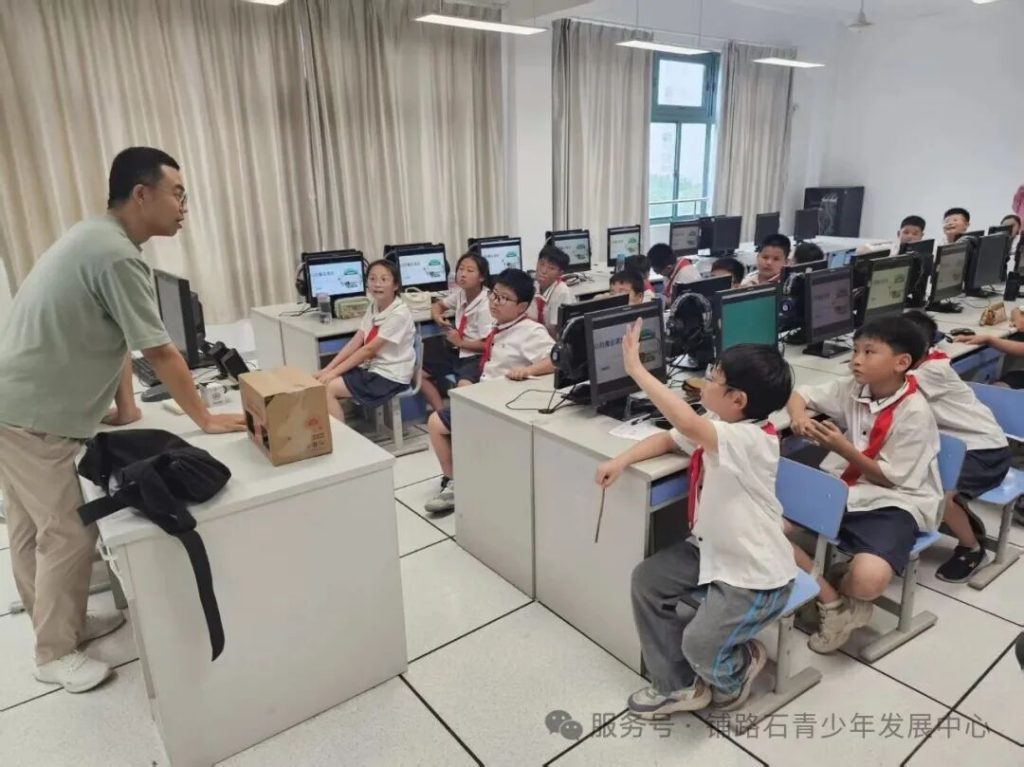
Using carefully selected clips, including some suggested by students, we analysed plot structure, characters, and storytelling techniques with the support of AI tools. By comparing examples, students explored the differences between more thoughtfully constructed content and fast-paced, easily consumable short dramas. When asked why one might prefer higher-quality content, students responded with thoughtful observations about depth, originality, and the space such stories leave for imagination.
Although my intention was not to change viewing habits directly, the discussion revealed the students’ strong capacity for media analysis. Their ability to articulate nuanced distinctions demonstrated critical thinking skills well beyond expectations for their age.
This experience reinforced my belief that, with the support of AI tools, personalized and exploratory learning is increasingly achievable. Such approaches nurture critical thinking, autonomy, and self-awareness — skills that will shape not only children’s educational journeys but also their development as lifelong learners.